

A ChartFundas Growth Story
1. The Spark
In 1993, three engineers — Jensen Huang, Chris Malachowsky, and Curtis Priem — sat in a Denny’s diner in San Jose and sketched out a company built on a narrow bet: that computer graphics, not general-purpose computing, would be the next frontier worth specializing in. They called it Nvidia. Their first products were graphics chips for video games — useful, but a small, cyclical, unglamorous corner of the tech industry compared to giants like Intel and Microsoft.
For most of the next two decades, that’s exactly what Nvidia stayed: a respected but secondary player, known mostly to gamers, riding the ordinary ups and downs of the PC and console hardware cycle.
2. The Struggle
The dot-com crash hit Nvidia hard, like it hit most tech companies of that era. Through the 2000s and into the 2010s, Nvidia remained boxed into the graphics card business — useful for rendering video game worlds, but seen by most of Wall Street as a niche hardware maker, not a company that could ever rival the trillion-dollar names of the technology world. Graphics chips were cyclical, margins thinned in lean years, and the company’s fortunes rose and fell with how excited gamers were about the next console or PC release.
What almost nobody outside the company fully grasped yet: the same chip architecture built to render explosions and shadows in video games — thousands of small calculations happening in parallel — was about to turn out to be exactly the kind of math that artificial intelligence needed.
3. The Turning Point
Through the 2010s, researchers training early neural networks discovered that Nvidia’s graphics processors (GPUs) were dramatically faster at the kind of parallel math AI models required than traditional computer chips. Nvidia leaned hard into this discovery, building software (CUDA) and hardware specifically aimed at AI researchers and data centers — years before “AI” was a mainstream conversation.
Then came the moment that changed everything: the public release of large-scale AI chatbots and generative AI tools starting in 2022-23 set off a global scramble. Every major tech company — Microsoft, Google, Amazon, Meta, and a wave of new AI startups — needed massive amounts of computing power to train and run these systems. And the chips best suited for that job were, overwhelmingly, Nvidia’s.
4. The Build-Out
What followed was one of the fastest wealth-creation events in corporate history.
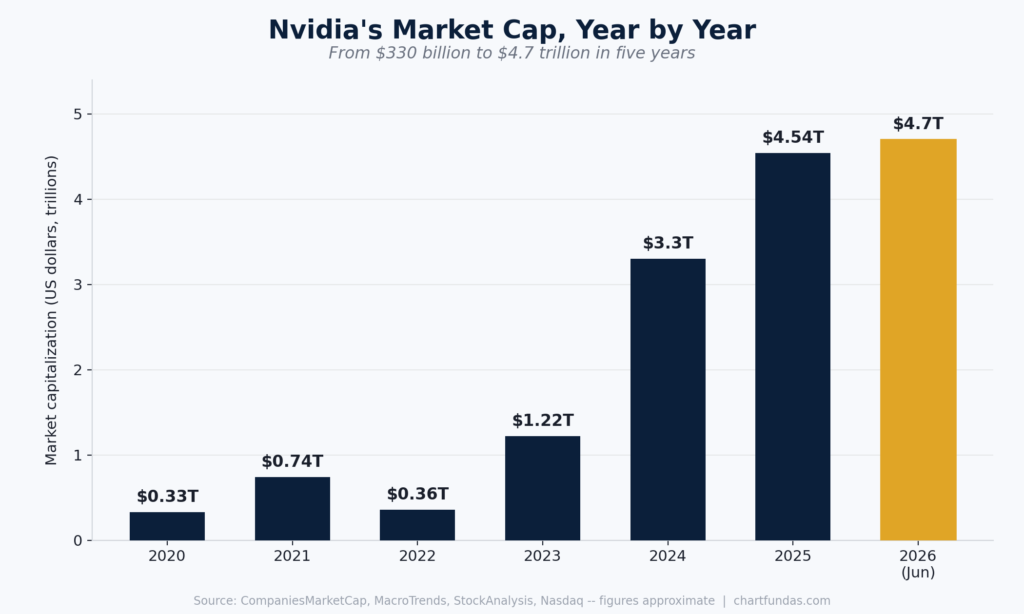
Nvidia ended 2020 worth roughly $330 billion — already a large company, but nowhere near the top tier. By the end of 2021, riding gaming demand and early AI interest, it had more than doubled to around $740 billion. Then 2022 hit: a brutal year for tech stocks broadly, and Nvidia’s value actually fell back to about $360 billion as the market cooled on speculative growth bets.
That dip didn’t last. 2023 was the year everything changed — Nvidia crossed the $1 trillion mark for the first time, as the AI boom kicked into gear and data centers everywhere started buying its chips. 2024 saw the company explode past $3 trillion, adding well over a trillion dollars in value in a single year — one of the largest single-year wealth increases by any company, ever. By the end of 2025, Nvidia stood at roughly $4.5 trillion.
In 2026, it kept climbing — briefly touching past $5 trillion earlier in the year, before settling around $4.7 trillion as of late June.
5. Where It Stands Now
As of June 2026, Nvidia’s market capitalization sits at approximately $4.7 trillion, making it the most valuable publicly traded company on Earth — ahead of Apple, Microsoft, and every other corporation on the planet.
The numbers behind that valuation are real: Nvidia’s data-center revenue alone grew from under $4 billion a year to well over $130 billion, as AI “hyperscalers” — the handful of giant cloud companies building AI infrastructure — poured hundreds of billions of dollars into Nvidia’s chips. Gross margins near 75% mean the company keeps an unusually large share of every dollar of revenue as profit, a rare combination of explosive growth and exceptional profitability.
6. The Takeaway
Nvidia’s rise from a $330 billion graphics-chip maker to a $4.7 trillion AI infrastructure giant in roughly five years is one of the fastest, largest wealth-creation stories in stock market history — and it happened to a company that, for most of its 30-year existence, was considered a solid-but-unspectacular hardware maker.
The lesson here isn’t really about Nvidia specifically. It’s about how markets price the future. Nvidia’s chips didn’t suddenly become more useful overnight in 2023 — the underlying parallel-processing architecture that makes them good at AI math is largely the same one built for rendering video games decades earlier. What changed was the world’s belief in what that architecture could be used for next. That’s the real engine behind a $4 trillion swing in five years: not a single new invention, but a sudden, widely-shared bet on where the next decade of computing is headed.
Whether that bet keeps paying off — or cools off the way it briefly did in 2022 — is the question every investor watching Nvidia is really asking.
Sources: Market capitalization figures from public market trackers (CompaniesMarketCap, MacroTrends, StockAnalysis, Nasdaq) as of late June 2026. Earlier-year figures reflect widely reported year-end levels and are approximate. Figures fluctuate daily with stock price movements.
Feedback or corrections? Write to us at chartfundas@gmail.com