
In 1975, India’s entire economy was worth less than ₹3 lakh crore.
Today it is worth over ₹300 lakh crore.
That is a 100x jump in 50 years. But this number alone tells you nothing. The real story is in the data — and what caused those dramatic rises and falls along the way.
## The Early Years — License Raj (1947–1990)
When India got independence in 1947, the economy was broken. Decades of colonial rule had drained the country of its resources, its industries, and its confidence.
For the next 40 years, India grew — but slowly. The government controlled almost everything. Businesses needed licenses for everything — to expand, to import, to hire. This system was called the License Raj.
GDP growth averaged just 3.5% per year during this period. Economists had a name for this — the Hindu Rate of Growth. Slow. Steady. Uninspiring.
And then everything changed.
## 1991 — The Year That Changed Everything
1991 was India’s darkest economic moment.
India had only $1.2 billion in foreign exchange reserves — barely enough to cover 3 weeks of imports. The country was so broke it had to physically fly 67 tonnes of gold to the Bank of England as collateral just to get an emergency loan.
But this crisis forced something remarkable.
Prime Minister Narasimha Rao and Finance Minister Manmohan Singh opened India’s economy to the world. They dismantled the License Raj, reduced import taxes, invited foreign investment, and let Indian businesses compete globally.
From 1992, India never looked back. GDP growth jumped from 3.5% to over 6%, then 7%, then 8%.
## The Growth Decades (1991–2010)
The 1990s and 2000s were India’s golden decades.
Software companies exploded. Infosys, Wipro, and TCS went from small offices to global giants. The middle class grew from 50 million people to over 300 million in just 20 years.
In 2007, India’s GDP growth rate hit 9.8% — the highest in its history.
## Shocks and Recovery (2008–2023)
The 2008 global financial crisis hit every economy. India slowed down — but never went into recession.
Then came two major shocks:
2016 — Demonetisation cancelled 86% of all currency overnight.
2020 — COVID-19 caused India’s GDP to shrink by 6.6% — the worst contraction since independence.
But India bounced back faster than almost any major economy in the world. By 2023, India was the fastest growing large economy on earth — again.
## Where India Stands Today
Today India is the 5th largest economy in the world with a GDP of over $3.7 trillion.
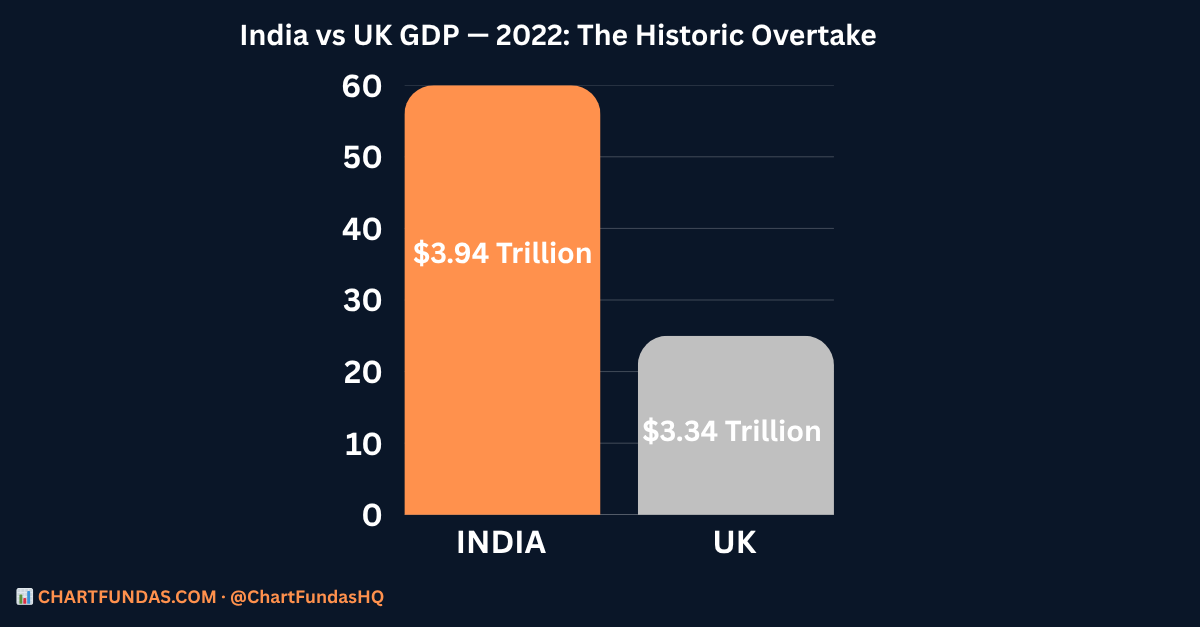
In 2022, India overtook the United Kingdom — its former colonial ruler — in economic size.
The country that was colonised, drained, and left broken in 1947 is now bigger than the country that colonised it.
## What the Data Tells Us
India’s GDP chart is not a smooth line. It has crashes, collapses, gold pledges, demonetisation, and a pandemic.
Every dip has a story. Every rise has a reason.
At current growth rates, India is projected to become the 3rd largest economy in the world by 2030.
The data of 50 years tells one clear story — India is a country that falls, learns, and grows stronger every time.
📊 Data Sources: World Bank (data.worldbank.org) | Reserve Bank of India (dbie.rbi.org.in) | IMF World Economic Outlook